

Payments Trends for finance leaders in 2026
Payments trends for
finance leaders in 2026
Real-Time Payment Systems: The New Standard
By 2026, global real-time payment volumes are expected to grow sharply, with significant adoption across major economies, according to analyses by SWIFT, ACI Worldwide, and Cebr on real-time retail payments.
This evolution is reshaping treasury operations and working capital management, and it demands strategic preparation from finance leaders.
Business Impact of Real-Time Payments
According to Mastercard, in 2026, we’ll see the rise of dynamic tools and platforms that can be customized for our own spending behaviors and financial goals, and a global massive growth of $250 trillion in cross-border payments by 2027. Meaning we should expect more innovation and investment in this field.
The acceleration to instant payments creates both opportunities and challenges for corporate finance. Companies can optimize cash positions with greater precision, reduce days sales outstanding (DSO), and enhance supplier relationships through instant payment options. However, this requires rethinking traditional payments systems.
As reported by Evertec, it’s estimated that over 60% of the global population will use digital wallets by 2026.
Fundamental steps to take:
- Evaluate your ERP and operational management systems for real-time payment readiness
- Develop new liquidity management strategies for instant payment transfers
- Adjust how you predict cash flow for real-time changes.
- Prepare for 24/7/365 operations
- Consider the competitive implications in your industry
Real-Time Payment Systems: The New Standard
By 2026, global real-time payment volumes are expected to grow sharply, with significant adoption across major economies, according to analyses by SWIFT, ACI Worldwide, and Cebr on real-time retail payments.
This evolution is reshaping treasury operations and working capital management, and it demands strategic preparation from finance leaders.
Business Impact of Real-Time Payments
According to Mastercard, in 2026, we’ll see the rise of dynamic tools and platforms that can be customized for our own spending behaviors and financial goals, and a global massive growth of $250 trillion in cross-border payments by 2027. Meaning we should expect more innovation and investment in this field.
The acceleration to instant payments creates both opportunities and challenges for corporate finance. Companies can optimize cash positions with greater precision, reduce days sales outstanding (DSO), and enhance supplier relationships through instant payment options. However, this requires rethinking traditional payments systems.
As reported by Evertec, it’s estimated that over 60% of the global population will use digital wallets by 2026.
- Evaluate your ERP and operational management systems for real-time payment readiness
- Develop new liquidity management strategies for instant payment transfers
- Adjust how you predict cash flow for real-time changes.
- Prepare for 24/7/365 operations
- Consider the competitive implications in your industry
Strategic considerations for CFOs
Cross-Border
Payment Innovations
International payment issues continue to be a major challenge for global businesses. However, new solutions are emerging.
By 2026, cross-border payments will be faster, more transparent, and less expensive due the raise of new technologies and infrastructure improvements.
Payment Corridors
and Network
New payment options are being created to meet local needs. These options are giving businesses choices beyond traditional banking. Using API systems and smart routing, these networks can move money faster and at lower cost in targeted regions.

ISO 20022 Migration
The global shift to ISO 20022 messaging standards is set to be completed by 2026. This transition will enhance data exchange capabilities across payment networks. The standardization allows better reconciliation, reduces errors, and facilitates advanced analytics for optimizing payments.
Organizations need to ensure that their payment systems can fully utilize the expanded data capabilities offered by ISO 20022. This includes adopting structured address formats, utilizing purpose codes, and incorporating enhanced remittance information. Legacy systems may need significant upgrades to remain compatible with global payment networks.
Strategic Considerations
for Global Businesses
AI-Driven Fraud Prevention and Risk Management
As payment volumes accelerate and channels multiply, sophisticated AI systems will become essential for fraud detection and prevention. By 2026, AI-powered security will be a critical component of payment infrastructure, with real-time risk scoring and anomaly detection capabilities. As stated by Experian, 90% of financial services will require compliance training for agentic AI by 2027.
Behavioral
Biometrics
Authentication will increasingly rely on behavioral patterns rather than static credentials. Such as Typing rhythm, device handling, and transaction habits will create unique user profiles that are nearly impossible to replicate, adding a powerful layer of security without adding friction.
Predictive Fraud Analytics
Advanced machine learning models will examine transaction patterns to spot potential fraud before it happens. These systems will learn from new data over time, adapting to changing threats and reducing false alarms that can interrupt real transactions.
Collaborative Intelligence Networks
AI-powered threat intelligence sharing networks will help organizations respond faster to new fraud schemes. Using federated learning techniques, organizations can gain insights together while keeping their sensitive data and competitive information safe.
Note that financial impact of payment fraud extends far beyond the direct losses. Reputational damage, operational disruption, and compliance penalties can multiply the cost for a long time.
Strategic considerations for CFOs
- Invest in AI-powered monitoring systems that scale with transaction growth
- Consider the implications of APP fraud reimbursement mandates
- Balance security with customer experience considerations
- Ensure fraud prevention strategies align with regulatory requirements
- Establish cross-functional governance for payment security
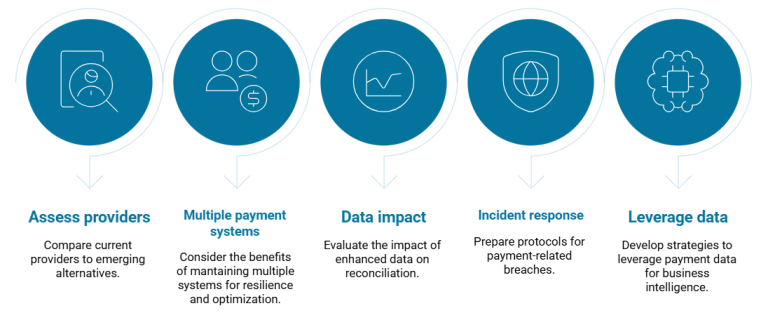
- Prepare incident response protocols for payment-related breaches
Strategic considerations for CFOs
- Invest in AI-powered monitoring systems that scale with transaction growth
- Consider the implications of APP fraud reimbursement mandates
- Balance security with customer experience considerations
- Ensure fraud prevention strategies align with regulatory requirements
- Establish cross-functional governance for payment security
- Prepare incident response protocols for payment-related breaches
Embedded Finance and Payment Orchestration
By 2026, embedded payment solutions will account for $1.1 trillion in global payment volumes as financial services become seamlessly integrated into non-financial platforms and experiences. This trend is transforming business models across industries and creating new opportunities for financial optimization.
Embedded Finance Applications
Financial services are now directly part of business processes and customer experiences. From supplier financing to insurance offerings, these services create new ways for businesses to enhance competitive advantage, create new revenue opportunities and improve their customer relationships.
The Rise of Payment Orchestration
Payment orchestration platforms are becoming essential middleware for businesses, managing multiple payment methods and providers. These solutions smartly route transactions, optimize cost and acceptance rates, and offer unified reporting between several payment channels.
With advanced capabilities, these platforms can change the route of transactions based on their features, costs, and performance. This flexibility enables organizations to optimize their payment strategies in real-time while ensuring a consistent customer experience.


Prepare Your Organization for the Future of Payments
Platforms like our w2bill payments, can be the all-in-one solution for the future of your financial management. Our latest whitepaper explores a comprehensive roadmap for leaders looking to transform their financial infrastructure from a cost center into a strategic engine for growth.
Conclusion: Preparing for the Payment Revolution
The payment landscape of 2026 will be defined by enhanced speed, intelligence, and integration. Organizations that invest strategically in payment capabilities will experience significant benefits in operational efficiency, customer satisfaction, and financial optimization.
CFOs play a crucial role in this transformation, balancing innovation with risk management while ensuring that payment strategies align with broader business objectives. By proactively addressing the trends outlined in this guide, finance leaders can position their organizations for success in an increasingly digital financial ecosystem. The time to prepare is now. Payment changes require careful planning and implementation, and organizations that delay until these trends become mainstream may find themselves at a competitive disadvantage.
The time to prepare is now. Payment changes require careful planning and implementation, and organizations that delay until these trends become mainstream may find themselves at a competitive disadvantage.
Conclusion: Preparing for the Payment Revolution
The payment landscape of 2026 will be defined by enhanced speed, intelligence, and integration. Organizations that invest strategically in payment capabilities will experience significant benefits in operational efficiency, customer satisfaction, and financial optimization.
CFOs play a crucial role in this transformation, balancing innovation with risk management while ensuring that payment strategies align with broader business objectives. By proactively addressing the trends outlined in this guide, finance leaders can position their organizations for success in an increasingly digital financial ecosystem. The time to prepare is now. Payment changes require careful planning and implementation, and organizations that delay until these trends become mainstream may find themselves at a competitive disadvantage.
The time to prepare is now. Payment changes require careful planning and implementation, and organizations that delay until these trends become mainstream may find themselves at a competitive disadvantage.
Stay Ahead of Payment Trends
Subscribe to our newsletter for regular updates on payment innovations, regulatory changes
and strategic insights for finance leaders.
CMAS – Systems Consultants, Lda
Edificio Escritorios do Tejo
Rua do Pólo sul , 2 D
Parque das Nações
1990-273 Lisboa
mail@cmas-systems.com